Start from a name, not a blank.
Choose each foot's size and a condition preset, and enter the weight. A preset is a named starting point: it fills in the values, and every value stays yours to change.
- size
- EU 42
- weight
- 78kg
- preset
- Healthy / comfort
A pair designed foot by foot from a named starting point, printed in TPU and engraved with your patient's name.
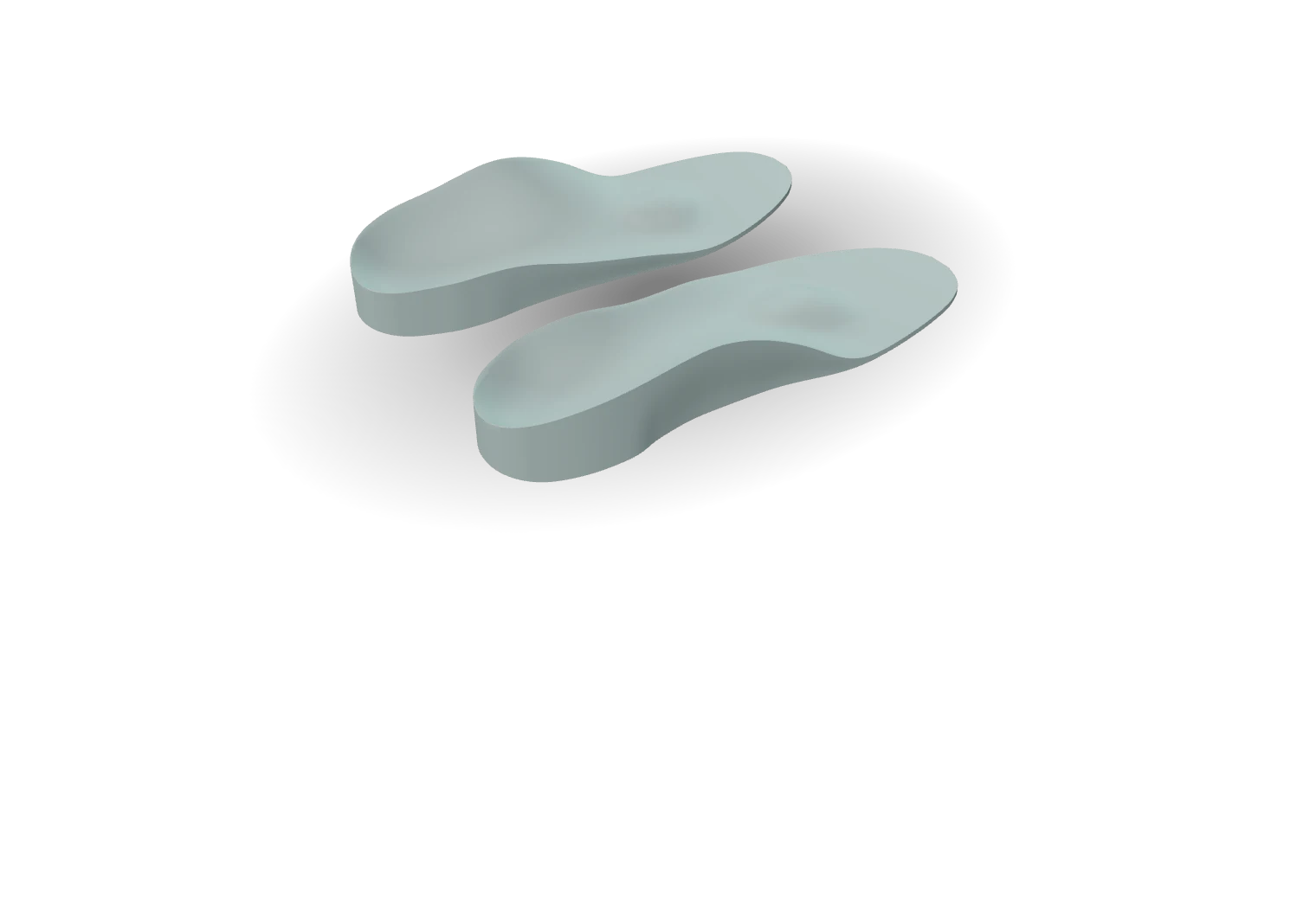 Drag to turn
The pair on this page was built by the insole engine itself, from a named preset and the four changes below, with the clinic and patient lines cut into the sole.
Choose each foot's size and a condition preset, and enter the weight. A preset is a named starting point: it fills in the values, and every value stays yours to change.
Four named steps, 30, 35, 40 and 45 mm, the same at every size, or any value in between. The glow shows where the surface moved.
Four steps from 20 to 35 mm deep. A separate control raises the medial wall without the lateral one.
Set its height, its position along the foot and its size. It is added to the surface, so when it is off, nothing of it remains.
Rearfoot and forefoot posts tilt the seat, from 6° valgus to 6° varus. Skives, flanges and the fit in the shoe are a tick away, under Advanced.
Every build is checked for minimum thickness, wall angle and a closed, manifold surface, and a file that fails is refused. Across every size from EU 20 to 50, seven presets and both feet, all 434 meshes pass.
Editing both feet together is on by default: in one clinic's work, 50 of 66 pairs were mirror images within half a millimetre. Untick it, and each foot has its own size, condition and values.
A value you have moved is marked, on the simple screen and under Advanced, and one click puts it back to the preset.
Both are optional, both are analysed in memory and never stored, and each proposal carries its source.
STL, PLY or OBJ, the whole foot or the sole alone. It proposes the arch height and the outline widths from the foot's shape, and never a cup, post, skive or pad. The load the foot was scanned under travels with every proposal.
The archive from a supported pressure plate moves the starting values by small, bounded amounts, each with a confidence and a reason. When the data is poor, it changes nothing.
With both scans, one table decides which scan sets each value: shape from the 3D scan, load from the pressure scan. The other value is still shown, struck through.
Type "heel raise right 8 mm, arch up 2 on the left". The studio lays out what would change, per foot, before anything does.
Each row shows the control, the foot, the value before and after, and the words it came from. Nothing changes until you apply the rows you ticked.
Dutch, German, English and Persian are read by rules on your own computer. A value out of range is refused with the range, and a clause it cannot read comes back as a question.
Hold to speak, and the words are transcribed on the same computer, then read back to you. Applying is still a click.
Each foot is printed in TPU 95A to the stiffness you prescribe. The clinic line and the patient's name are cut into the sole, in the file itself, so the part and the record agree.
Drag to turn
€55per pair
€50 from 10 a month · €45 from 30 a month · download only: €9
It is named, it is chosen by you, and it treats nothing. The studio never picks one for a patient.
The studio does not diagnose, prescribe or approve a fit. Those are yours, and the software is built so they stay that way.
Classification of Avesta Studio under the EU Medical Device Regulation has not yet been confirmed by a regulatory assessor, and we will not tell you it has.
We set up the software in an afternoon, train your team and make your first parts free. At the end of the month, you decide.